







Hospital Visitor Management System: Patient Safety and Healthcare Security
Hospitals and healthcare facilities have unique and complex security and operational requirements. Their challenges escalated to an entirely new level during the 2020 coronavirus pandemic. Operational requirements such as better visitor screening, access control, and infection prevention continue to increase in their relevance. A dedicated visitor management system for hospitals helps address them while accounting for the diverse people and activities across hospital premises.
Why Manual Reception Logs Fail in High-Footfall Hospitals
Hospital premises encompass more than healthcare facilities. They include a wide range of services and amenities for patients, visitors, and staff. Some of the large hospital campuses may even have medical colleges, university facilities, and student hostels.
Most hospitals typically operate from massive buildings and campuses, serving hundreds or thousands of patients and their visitors every day. They also house many high-worth physical assets. Add to this the different categories of people, including staff, contractors, labourers, medical representatives, technicians, and vendors, entering and leaving the premises throughout the day.
Types of Visitors in a Hospital
Patient-Connected Visitors
- IPD Patient Attendants (Bystanders)
- Casual Social Visitors
- OPD and Day-Care Companions
Clinical and Healthcare Affiliates
- Visiting Consultants and Guest Surgeons
- Medical Students, Interns, and Clinical Observers
- Medical Representatives (MRs) and Pharma Reps
Diagnostic, Supply Chain and Delivery Personnel
- Pathology, Diagnostic, and Blood-Bank Couriers
- Food, E-Commerce, and Floral Delivery Riders
Technical, Facility, and Regulatory Visitors
- Biomedical Engineers and Equipment Vendors
- Facility Contractors and Maintenance Crews
- Accreditation Auditors, Government Inspectors, and Insurance TPAs
Managing this level of activity and movement requires more than a reception register or a basic check-in process. It needs a proper visitor management system that can support hospital security and operations without disrupting the delivery of patient care.
Enforce Visiting Hours and Prevent Ward Overcrowding with Auto-Generated Custom Visitor Passes
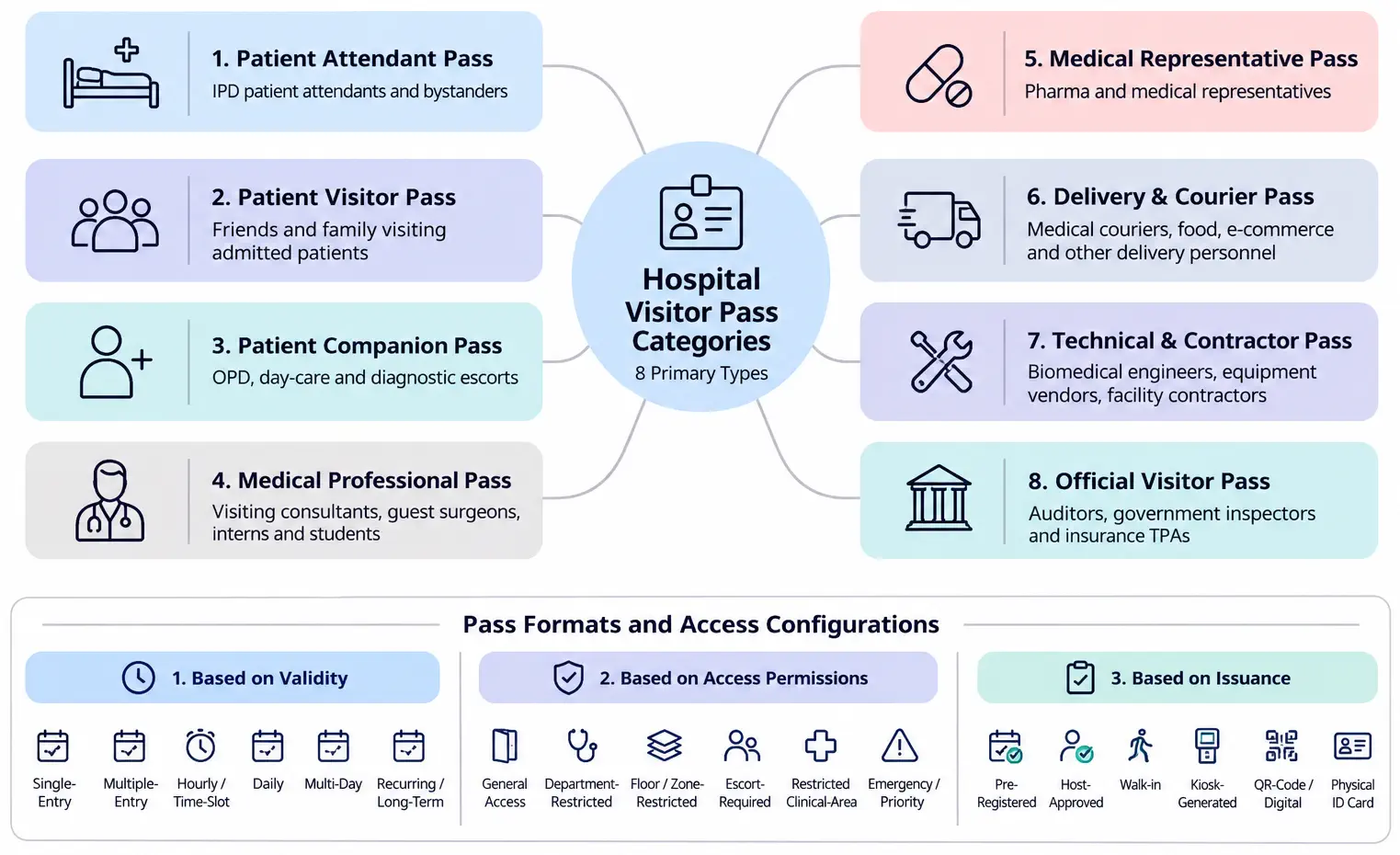
A visitor management system for hospitals identifies and records different categories of visitors. This means it also has the capability to issue custom visitor passes such as passes with pre-assigned validity periods, access permissions, and visiting hours. These can be QR-code-based epasses or system-generated print passes.
Digital passes also solve two practical challenges–unreturned plastic tags and infection risks. While the staff waste time manually renewing multi-day paper passes, visitors walk out without returning physical lanyards/badges. Replacing reusable tags with auto-expiring QR epasses doubles as an extra layer of safeguard against infections by removing shared touchpoints.
Configurable Data Capture Per Visitor Category
A flexible VMS adapts to different operational needs. For example, you can capture minimal data for quick OPD escorts and maximum details (ID, photo, company, etc.) for contract laborers, biomedical technicians, and medical representatives.
Enforcing limits on the number of attendants permitted per patient is another practical challenge. The visitor system can be configured to generate time-bound passes that automatically expire when visiting hours end, preventing extended visits. At the same time, it generates longer-term passes for regular attendants and approved visitors with defined access rights and renewal periods.
Integration with access control systems allows these permissions to be enforced at physical entry points.
Automated Hospital Visitor Check-In System and Access Control for High-Risk and Restricted Zones
An automated hospital visitor check-in system is necessary to enforce role-based entry rules across clinical areas.
While QR passes are useful for general visitors, IPD rooms need to limit a strict quota of one or two attendants per patient. This makes authentication-linked access control a necessary part of a hospital visitor management solution. Controls such as biometric or QR authentication linked to flap barriers and electronic door locks are necessary in high-security zones, including ICUs, NICUs, maternity wards, and operating theatres.
As an enterprise visitor management system for hospitals, VersionX VMS brings all visitor related operations into one unified platform. Its hardware-agnostic platform integrates with existing access control and barriers, elevator systems, and hospital management systems (HMS), allowing hospitals to extend visitor governance without replacing their existing infrastructure.
Managing Medical Representatives (MRs), Vendors, and Diagnostic Couriers
A VMS can restrict medical representatives (MRs) to approved OPD time slots (versus having MRs roaming clinical corridors).
Timed passes for biomedical engineers and quick gate logging for pathology/blood-bank couriers help enforce safety rules.
Third-party contractors must be logged and briefed on safety and infection-control protocols, and restricted strictly to their authorized work zone and permit duration.
Mobile App for Roving Ward and Gate Guards
Equipping security personnel on hospital floors and secondary entrances with a mobile visitor app strengthens the visitor process. On-duty guards can scan passes to verify visitors, check patient-attendant quotas on the spot, and check out visitors at exit gates. Check-out controls keep real-time occupancy logs accurate for emergency evacuations.
Visitor Self-Registration Through Kiosk Sign In
In India, large hospitals have receptionists not just in the main atrium, but across individual clinical wings (such as oncology, pediatrics, diagnostics).
Kiosk sign-in is an efficient way of handling visitors, especially, pre-registered visitors. Self-service or self-registration kiosks with multi-language prompts and department-specific fields at wing entrances relieve overburdened departmental receptionists (when used as a complement to other check-in modes).
Maintaining Hospital Safety, Security, and Data Privacy Standards
A VMS helps hospitals comply with NABH and JCI patient safety and security standards. Digital visitor audit trails and emergency evacuation logs provide visibility into visitor movements and accountability during critical incidents. Real-time visitor and occupant movement records help security teams identify who is on-site, conduct evacuation roll calls, and reconcile entry and exit records.
Patient-Managed Guest Lists and "Unwanted Visitor" Blocking
VMS supports patient privacy, VIP suites, and sensitive clinical admissions. It allows admitted patients or their primary attendants to pre-approve their own guest list for automatic visiting-hour access—and explicitly flag specific individuals as "unwanted visitors" so reception and gate guards block entry discreetly.
Applying configurable data retention and auto-purge policies for visitor personal data help compliance with India's DPDP Act and relevant HIPAA privacy requirements where applicable.
Operational Insights from Hospital Visitor Management System
Hospitals often have multiple entry and exit points, with larger chains operating branches across different locations. A visitor management system helps the security and operations team manage them through a centralised dashboard, providing real-time reports and policy control across gates and branches. Drill down data such as patient-level and department-wise crowd analytics are immensely helpful for insights-based decision making.
Tracking active visitor count per admitted patient, department-wise crowd density, and average visit duration give hospital administrators concrete metrics to adjust visiting-hour rules and redeploy security staff.
Finally, while standalone tools like visitor management, parking, guard patrol, etc. operate independently with separate records and workflows, a unified physical operations platform brings all processes together. Unified solutions like those offered by VersionX are designed to strengthen security, support audit readiness, and protect patient privacy. One major reason a platform allows businesses to coordinate operations and security across gates, buildings, sites, and systems.