






Physical Operations 101
Physical Operations are operations in the real, physical world that organizations perform to ensure security, safety, compliance, and business continuity. It refers to the management of tangible assets, people, material, vehicles, and buildings in a physical environment across premises and locations.
Physical operations in modern enterprises include hardware and software systems and processes across workforce, visitor, access control, parking, physical identity, physical security, building and critical infrastructure, workplace experience.
VersionX Physical Operations Platform is a unified platform that governs and orchestrates physical operations across enterprise premises and locations such as movement of people (employees, visitors, contractors, vendors) and material; usage, maintenance, and movement of assets, equipment, and vehicles; usage and maintenance of buildings, facilities, energy, and utilities.
It is the larger category that includes PACS (Physical Access Control Systems), Smart Parking & ANPR Systems, VMS (Visitor Management Systems), PIAM (Physical Identity and Access Management), BMS (Building Management Systems), PSIM (Physical Security Information Management), Workplace Experience Platforms, IWMS (Integrated Workplace Management Systems), PropTech, Smart Building Platforms, and so on.
The Physical Operations Framework
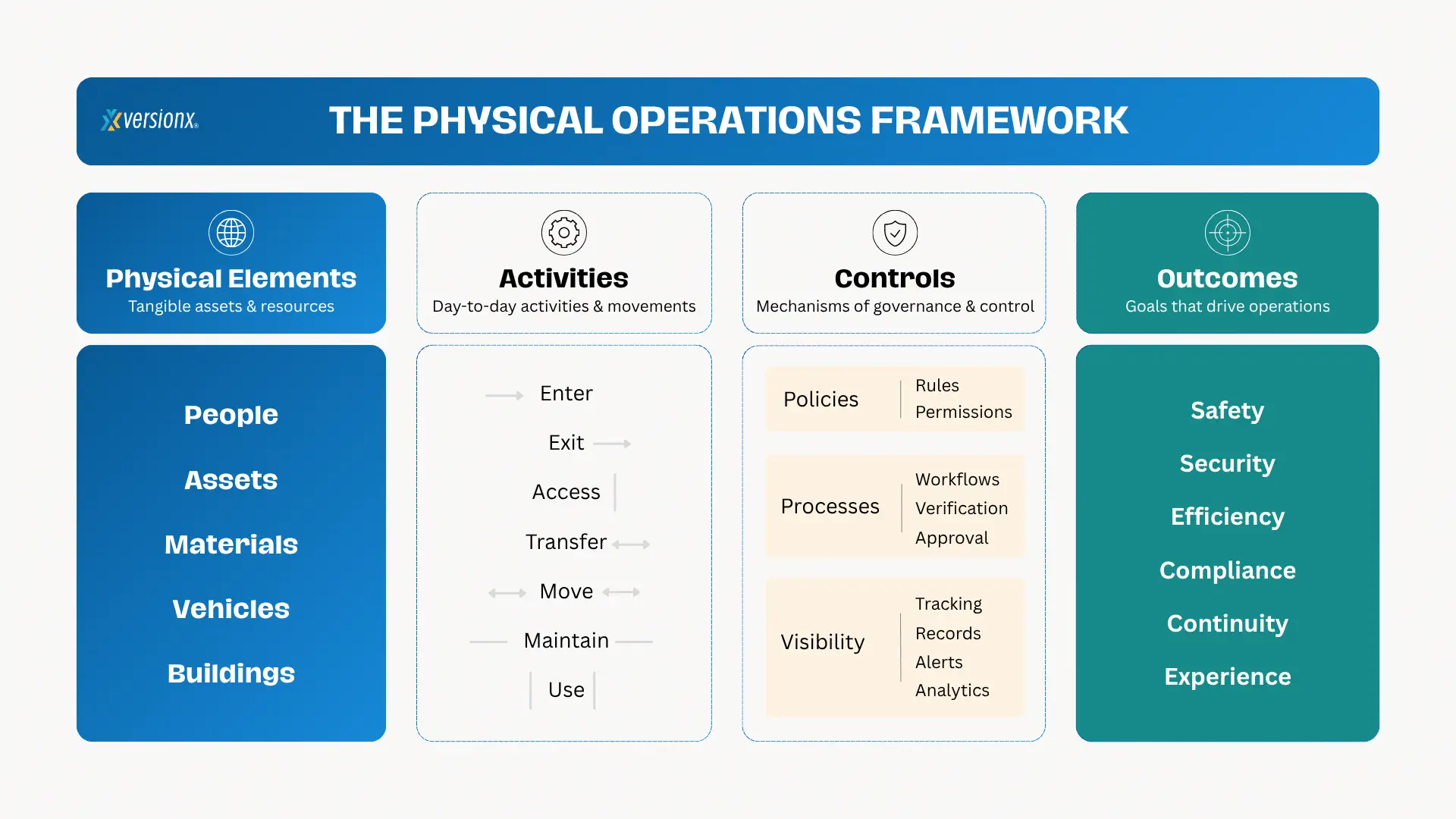
The Physical Operations Framework provides a comprehensive understanding of “physical operations” by examining it through the following four dimensions of operations and their interconnectedness:
- 1The Physical World Elements
- 2Activities
- 3Controls
- 4Outcomes
What Physical Operations Comprise
1. Physical World Elements
These are tangible, real-world elements that organizations manage such as people, assets, materials, vehicles, buildings.
2. Activities
Physical world elements act and interact such as enter, exit, access, move, transfer, use, maintain.
3. Controls
Organizations control physical world elements and their activities through mechanisms such as policies and procedures.
4. Outcomes
Physical operations ultimately exist to produce desired organizational and business outcomes such as safety, security, efficiency, compliance, continuity, experience.
How the Four Dimensions Connect
The Physical Operations Framework uses a simple logical structure:
Physical-world elements participate in activities. Activities require controls. Effective controls contribute to desired outcomes.
Elements → Activities → Controls → Outcomes
This structure remains constant across industries even as the contents within them may change from business to business.
A Unified Approach to Physical Operations
Organizations across industries manage physical operations through separate functions even when, in reality, they are interconnected. The Framework examines this interconnectedness and offers a comprehensive understanding of physical operations.
Why A Unified Approach Matters
Managing physical operations in isolation prevents organizations from gaining a comprehensive understanding of their operations. Fragmented operations affect informed decision-making, organizational goals, and business outcomes.
Learn More About the Framework
Let's Learn More About Physical Operations

Hello there!
I'm Flo. I spend my days around your buildings, watching how humans work. At night, I nest in the VersionX office. Well, I’m part of the team. Here, I share with you all I have learned about physical operations, one crumb of insight at a time. Hope you enjoy learning with me.