







Visitor Parking Management: Unified VMS, Parking and Access Control
Managing visitor parking is not just about finding an empty parking bay. It involves identifying incoming vehicles, checking visitor appointments, allocating available spaces, and controlling vehicle entry and exit. Visitor parking management becomes particularly challenging in large facilities where multiple entry gates, parking zones, and high visitor volumes need to be managed at the same time. It gets even more complex in commercial multi-tenant complexes with a common entry for multiple companies.
Traditional methods rely on guardhouse clipboards, manual slot registers, and walkie-talkie checks between security personnel and parking attendants. This makes it difficult to track available spaces, avoid double allocation, and maintain accurate vehicle records. Visitor parking management software replaces these manual checks with digital slot allocation, vehicle identification, and real-time occupancy tracking. It connects visitor registration, parking reservations, and physical access control through one system.
In this blog, we discuss how such a unified system can solve visitor parking challenges.
1. How a Visitor Parking Management System Automates Guest Bay Allocation
A visitor parking management system can automatically assign parking spaces based on vehicle type, availability, visitor category, and designated parking zones. For example, a corporate campus may have separate bays for two-wheelers, four-wheelers, VIP guests, and tenant visitors. The system checks available capacity and reserves an appropriate slot when a visitor arrives or completes pre-registration. This eliminates the need for manual checks and coordination.
Once a slot is assigned, the visitor can receive a parking QR pass through WhatsApp or SMS, depending on the configured notification channels. The pass can include the allocated bay, entry gate, and directions to the designated parking area. For large facilities, the system can also direct vehicles to specific basement levels, surface parking zones, or tenant-designated areas. This is particularly useful in multi-tenant IT parks where parking quotas and availability differ across organisations.
See how this works in practice: Unified Visitor, Parking and Access Control at an IT/ITeS Park. The VersionX implementation brought together 17 business tenants, visitor management, parking allocation, and physical access control, handling approximately 2,000 daily visitors across multiple entry points.
2. Integrating Your VMS Parking System with Visitor Pre-Registration
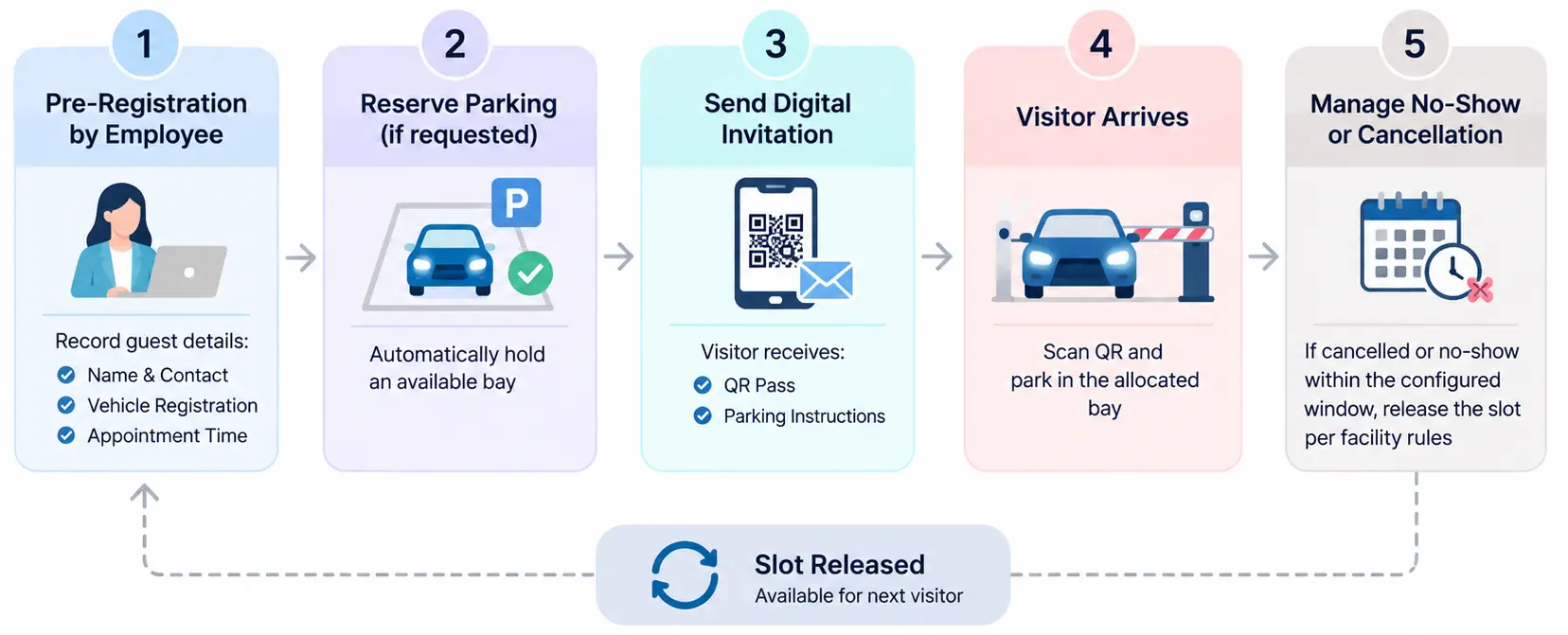
A visitor parking system connects visitor appointments with parking reservations. When an employee or tenant administrator sends a meeting invitation through the Visitor Management System (VMS), the system can capture the visitor's vehicle details and reserve an available parking slot for the scheduled visit. This means the visitor's appointment and parking allocation are handled as part of the same process.
For example, when an employee schedules a meeting with a guest, their name, contact details, vehicle registration number, and appointment time are recorded during pre-registration. If parking is requested, the system automatically holds an available bay against that appointment. The visitor receives a digital invitation with a QR pass and parking instructions before arrival. If the appointment is cancelled or the visitor does not arrive within the configured window, the reserved slot can be released according to the facility's parking rules.
3. Automated Parking Access Control: ANPR Cameras, RFID Tags, and Boom Barriers
Parking allocation alone does not control vehicle movement. The next step is to verify that the vehicle arriving at the gate is authorised to enter and has a valid parking reservation. An integrated parking and access control system connects the VMS, parking software, vehicle identification devices, and physical barriers. This allows the system to validate visitor credentials and parking permissions before opening the entry barrier.
Automatic Number Plate Recognition (ANPR) cameras capture the vehicle's registration number and check it against the visitor's approved appointment and parking allocation. RFID readers can authenticate registered vehicles using windshield tags, while QR scanners can validate digital passes issued to one-time visitors. Once the credentials are verified, the system triggers the boom barrier to open.
The same process can be applied at exit points to record vehicle departure, release the allocated parking space, and update occupancy records. Existing boom barriers and access control hardware can be connected through IoT controllers, depending on the site's infrastructure.
4. Automated Visitor Car Parking Workflows for Corporate Offices, Hotels, and Gated Communities
Different facilities have different visitor car parking requirements. In corporate offices, parking allocation may depend on employee hosts, tenant quotas, meeting schedules, and visitor categories. Hotels may need to distinguish between guest parking, short-duration visits, conference attendees, and VIP arrivals. A connected system can apply different parking rules for each category, allocate suitable spaces, and maintain records of vehicle entry and exit.
Gated communities have another set of requirements. Residents may pre-authorise guest vehicles, approve delivery or service vehicles, and reserve visitor parking based on available capacity. Security personnel can verify the vehicle against the resident's approval before allowing entry. The system can also maintain records of recurring visitors and vehicles. These controls complement other residential security measures, as discussed in our article on gated community security management.
5. Visitor Vehicle Management: Live Occupancy Tracking, Overstay Alerts, and Audit Logs
Effective visitor vehicle management requires visibility beyond the entry gate. Security and facility teams need to know which vehicles are currently inside the premises, where they are parked, how long they have stayed, and whether they have exceeded their permitted parking duration. A visitor vehicle management system maintains these records by linking vehicle identification, parking allocation, and entry-exit transactions. Live occupancy data helps facility managers monitor available spaces across different floors, zones, and parking categories.
The same records can support overstay alerts, valet operations, and VIP vehicle coordination. For example, when a visitor exceeds the permitted parking duration, the system can notify security or administration for follow-up.
In facilities with valet services, a valet management system can record vehicle handovers, assign vehicles to valet attendants, track their parking status, and manage retrieval requests. VIP vehicle movements and valet assignments can also be recorded for better accountability. Digital logs provide an audit trail of vehicle registrations, parking allocations, access events, overstays and departures, helping facility teams investigate exceptions and review parking usage.
Bringing Visitor, Parking, and Access Control Together
Coordinating visitor entry, parking allocation and access to doors, elevators and restricted areas takes more than installing individual devices or software applications. It requires a unified platform where visitor management, parking management, and access control work together, share information, and trigger actions based on common workflows. Without this coordination, organisations end up managing disconnected systems and relying on manual intervention to fill the gaps.
Technology, however, is only part of the solution. Effective implementation requires an understanding of how people and vehicles move through different facilities and how their processes are managed. A corporate office, hotel, residential community, or factory will have different visitor categories, parking rules, approval workflows, and access requirements. Replacing existing processes with a rigid system can create confusion and resistance. The technology should instead adapt to these operational requirements and automate repetitive tasks without disrupting established workflows.
For example, a corporate office may allocate parking based on employee-hosted meetings, while a gated community may require resident approval before a visitor's vehicle is admitted. Both need reliable vehicle identification, parking visibility, and access control, but the workflows are different. An effective platform accommodates these differences while maintaining consistent control over people, vehicles, and premises.
The future of visitor and parking management lies in unified systems that can adapt to different operational environments and scale with changing requirements. When technology and process understanding come together, organisations gain more than automation such as better visibility, stronger control, and a more accountable way to manage their physical operations.