







College Campus Security System: Access, Hostel and Visitor Management
A large college or university campus is not a conventional workplace. Thousands of students, faculty members, researchers, visitors, vendors, and service vehicles move through its gates every day. Some buildings remain active around the clock, while others have restricted access or specific operating hours. Managing this movement through paper registers, disconnected CCTV cameras, and standalone security systems creates gaps in visibility and control.
A college campus security system must account for these realities. It needs to do more than monitor gates and record incidents.
VersionX unified platform brings access control, visitor management, hostel security, vehicle movement, surveillance, emergency response, and building operations into a common system. This allows the security and administration teams to manage the campus as a whole.
1. Why Multi-Gate Colleges and Universities Need a Unified Campus Security System
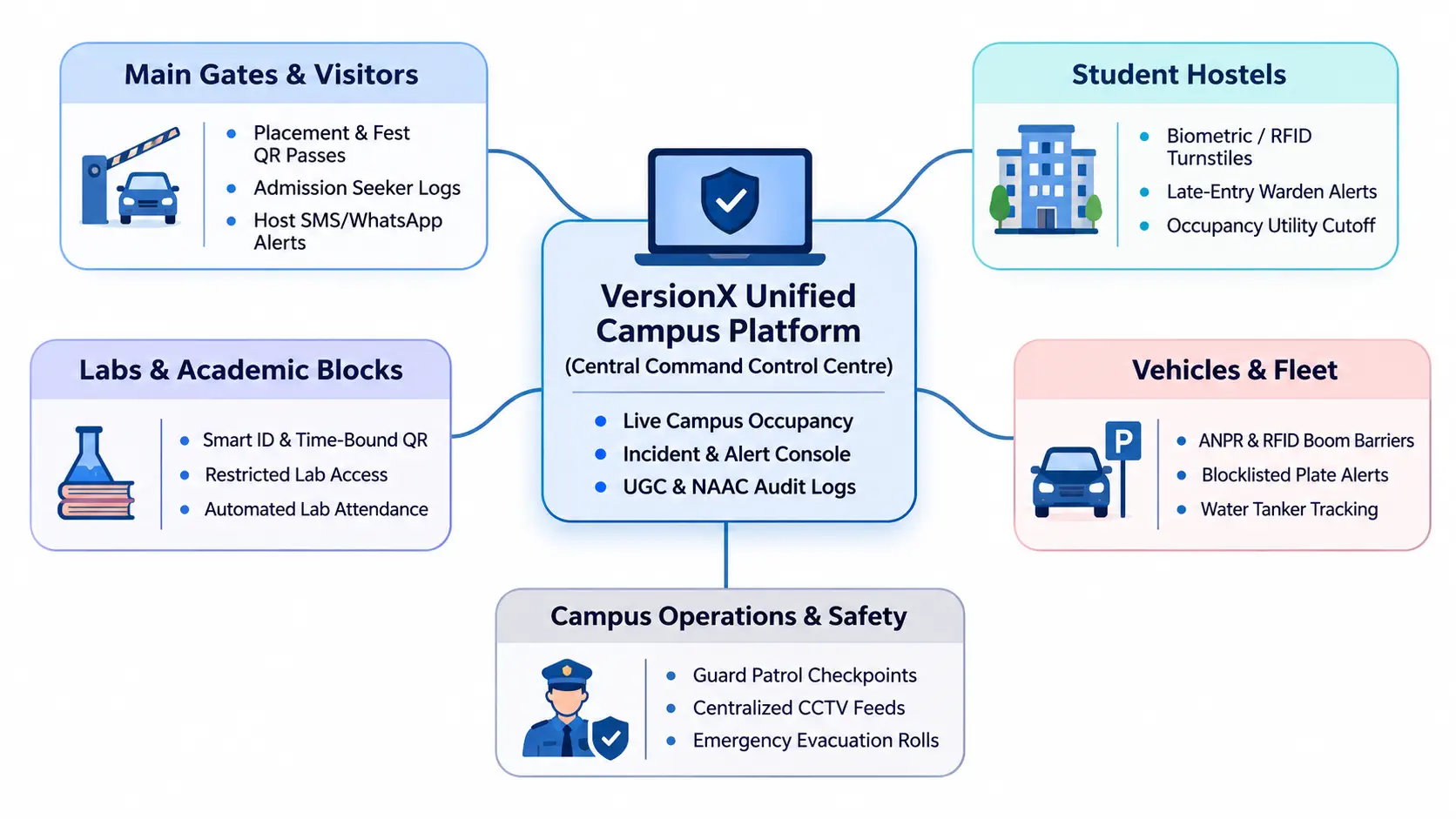
A sprawling university campus may have several entry and exit gates, academic blocks, hostels, laboratories, libraries, administrative buildings, and service areas. Students and staff move between them throughout the day. Researchers, admission seekers, contractors, vendors, delivery personnel, and visitors add to this movement. Each gate and building may have different security requirements.
When these activities are managed through separate registers, CCTV consoles, and standalone applications, the security team has to piece together information from multiple sources. A visitor entering one gate, a vehicle arriving at another, or a student accessing a restricted building may not be visible in a single operational view.
A university security management software brings these activities together without treating every gate or department as an isolated operation.
2. Student Hostel Access Control, Curfews, and Residential Security
Hostel security involves more than verifying who enters a residential block. Institutions must account for student entry and exit, late-night reporting, external guests, and access to individual hostel buildings. Access control such as facial recognition, RFID credentials, or biometric turnstiles help record student movement and restrict entry to authorized residents.
Hostel room access links room occupancy to electricity and water management. The institution can monitor room occupancy and automate utilities, which reduces unnecessary consumption when rooms are vacant.
Enforcing late-entry rules through automated alerts to hostel wardens and parents or guardians helps manage hostel entry-exit timings and permissions as per the institution's policy. Pre-registering external hostel visitors helps quick verifications at the gate, with escort requirements enforced where necessary. These measures replace manual checking with a consistent process for residential security and accountability.
3. University Visitor Management for High-Volume Traffic During Placements, Guest Lectures, and College Fests
Campus visitor management becomes particularly challenging during placement drives, admission season, alumni gatherings, and cultural or technical festivals. Corporate recruiters, visiting faculty, parents, alumni, and event participants may arrive in large numbers, often at the same time. Managing each arrival through a manual entry register slows down the gate and leaves security personnel with limited information about who is expected.
Explore how high-volume visitor management works in practice: Read a case study
Pre-registered visitors with QR-based passes through SMS or WhatsApp, allows security teams to verify their details at entry. Event-specific registrations help manage visitors attending multiple-day fests or scheduled campus activities.
Identifying Repeat Visits by Admission Seekers
Admission-related visitors are a distinct category in campus security.
While the system records their purpose of visit and helps identify repeat visits for further verification, genuine admission seekers typically visit for a specific purpose and may not need to return repeatedly for the same enquiry.
The system flags unusual patterns, such as repeated visits by individuals claiming to be prospective applicants.
While this does not automatically imply suspicious intent, it is a practical on-ground challenge in most college campuses. An additional layer of scrutiny to identify potential risks that may otherwise go unnoticed always helps.
4. University Access Control for Research Labs, Libraries, and Restricted Areas
Engineering labs, chemical and biotechnology research facilities, examination control rooms, server rooms, and central libraries often have different access requirements from general academic buildings. Students may be authorized to enter only specific labs or classrooms, while faculty, researchers, and administrators require access based on their roles. Access control systems including Smart ID cards, biometrics, and time-bound QR passes enforce these restrictions without relying entirely on manual verification.
Access records also help monitor attendance in labs and specialised classes, reducing the time teachers spend on manual attendance.
CCTV cameras placed near access-controlled areas help detect attempts to tamper with access devices. The same system can enforce entry restrictions across academic blocks, libraries, and other sensitive areas, while maintaining a record of who accessed them and when.
5. Campus Vehicle Management, UGC Safety Compliance, and Emergency Response
Vehicle movement across a large campus needs its own set of controls. Faculty, students, guests, delivery vehicles, contractors, and service vehicles may use different gates or parking areas. RFID windshield tags, ANPR cameras, and boom barriers help identify vehicles, regulate entry, and separate different categories of visitor parking traffic. Number plates can also be checked against a block list, with alerts sent to security personnel when a flagged vehicle is detected.
Water tanker and other service vehicle records also need to be tracked, with entry records, dispensing measurements, and rate-card calculations helping the administration verify usage and costs.
Security operations extend beyond gates and access points. Examples include:
- Guard patrol: Verify guard patrols at designated checkpoints and maintain digital records of patrol rounds.
- Housekeeping inspections: Record inspections through digital checklists to track completion and follow up on pending issues.
- Centralised CCTV management: Manage CCTV footage centrally with defined retention periods.
- Command control centre: Bring CCTV feeds, public announcements, access events, incident reports, and campus-wide occupancy information into a single view.
- Emergency response and evacuation: Use incident records and real-time occupancy information to coordinate emergency response and evacuation headcounts during emergencies or lockdowns.
- Safety audits and accreditation: Maintain centralised logs to support UGC safety requirements and NAAC infrastructure and safety reviews.
- Building and infrastructure management: Monitor electricity, water, generators, pumps, and other infrastructure through building management systems to automate operations and reduce resource wastage across campus.
A Campus-Wide System Requires More Than Technology
A campus-wide security and automation initiative is not just a technology deployment. It requires leadership, consistent enforcement, and participation from security, administration, facilities, hostel management, and other departments. These teams must work toward a shared objective rather than operate within their own silos. Disagreements, practical discussions, and a willingness to question existing processes are part of getting the implementation right.
Digital transformation also requires a change in mindset. Data must be captured across processes, and paper registers should gradually give way to accountable digital records. The objective is not to automate every activity for the sake of it, but to identify where automation, monitoring, and centralized control can make a real difference. With the right approach, a campus can move beyond standalone security systems to a unified operational environment that supports safety, accountability, and efficient resource use.
At VersionX, we work with institutions to understand these ground-level requirements before defining the system. Our Physical Operations Platform brings security, access, visitor, vehicle, infrastructure, and administrative processes together under one platform, with scope for automation based on the institution's needs.
If your institution is exploring a campus-wide security and automation initiative,connect with VersionX to discuss the requirements and possibilities.